
What Makes Mortgage One of the Best Career Paths for Women?
Download the free Salary Guide to discover what your license could be worth.
Mortgage lending sits at a unique point in its evolution. Unlike real estate, where two-thirds of REALTORS are women, or insurance, where women hold nearly 60% of the workforce, mortgage is a field where women are approaching parity but haven't yet fully claimed leadership.
According to Bureau of Labor Statistics dataCpsaat11.htm Cps, women represent 52.8% of loan officers and credit counselors nationally. In bank-based mortgage lending specifically, women make up 55.2% of the workforce. In independent mortgage companies, that drops to 44.8%.
What this means: mortgage isn't women-dominated the way insurance is. It's more like a frontier. Women who enter now have the opportunity to help shape the culture, build the leadership pipeline, and establish themselves in a financial services career that pays more at the median than either real estate or insurance.
The Highest-Paying Homeownership Career
The financial case for mortgage lending is straightforward. According to the Bureau of Labor StatisticsBusiness And Financial Loan Officers.htm Ooh, loan officers earn a median annual wage of $74,180. That is meaningfully higher than the median for real estate sales agents ($56,320) and insurance sales agents ($60,370).
The higher earnings reflect the financial stakes involved. Mortgage loans are among the largest financial products most Americans will ever use. A single loan can represent hundreds of thousands of dollars, and the origination commissions scale accordingly. Even modest loan volumes can generate substantial income for an MLO who manages the process efficiently and earns repeat referrals.
Compensation models vary by employer. Banks and credit unions typically offer a base salary plus per-loan bonuses, providing more income predictability. Brokerages tend toward higher commission splits with less base salary, rewarding volume producers. Understanding these differences helps you choose the structure that best fits your risk tolerance and financial situation. The guide to MLO commission structuresPre License What Does Mortgage Loan Officer Commission Actually Look Like Resources breaks this down in detail.
First-year MLOs typically earn between $40,000 and $60,000 as they build their pipeline and referral network. Experienced originators with established client relationships and real estate agent partnerships regularly earn over $100,000. Top producers in active housing markets earn well beyond that.
Women Are Leading Insurance. You Could Be Next.

Why the Work Rewards the Right Skills
Mortgage origination is fundamentally advisory work. Borrowers are navigating one of the most complex financial transactions of their lives, and they need someone who can translate jargon into plain language, manage expectations, and guide them through a process that involves significant documentation and timelines.
The skills that consistently predict MLO success are active listening, clear communication, attention to detail, and empathy under pressure. When a deal hits a snag, an appraisal comes in low, or a borrower gets nervous, the loan officer who handles it with calm professionalism is the one clients remember and recommend.
The client base reinforces this alignment. According to the NAR Profile of Home Buyers and SellersResearch Reports Highlights From The Profile Of Home Buyers And Sellers Research And Statistics, 21% of all homebuyers are single women, more than double the 9% who are single men. Among first-time buyers, single women represent 25% of the market. Women loan officers serving women buyers isn't just representation. It's a market reality that creates business opportunity.
Flexibility Without Sacrificing Earning Power
The mortgage industry has embraced remote work more aggressively than most financial services sectors. Many MLOs work from home offices, take client meetings virtually, and set schedules that accommodate their lives rather than the other way around.
The commission-based nature of the role makes this flexibility financially viable. Your income correlates with loan volume and performance, not hours in a chair. This is why part-time mortgage careersPre License A Day In The Life Of A Part Time Mortgage Loan Originator Resources are increasingly common and increasingly profitable for women who want to build a book of business on their own timeline.
For women already working in adjacent homeownership careers, adding a mortgage license expands what you can offer clients and earn from each relationship. Real estate agents who also originate loans can serve clients across the full homebuying journeyPre License Should Real Estate Agents Get Their Mortgage License Resources, earning commissions on both the property sale and the financing. Insurance agents who understand mortgage bring valuable perspective to homeowner coverage conversations.
The Licensing Path Is Short and Accessible
Getting licensed as a mortgage loan originator follows a structured national process under the SAFE Act. You complete 20 hours of NMLS-approved pre-licensing educationMortgage.nationwidelicensingsystem.org, including federal law and ethics coursework. You pass the SAFE MLO exam with a score of 75% or higher. You submit your license application, complete a background check and credit review, and get sponsored by a licensed employer.
No college degree is required. The entire process typically takes four to eight weeks for motivated candidates. Many people complete their education while still working their current job, studying on evenings and weekends through online coursework.
Some states require additional hours beyond the 20-hour federal minimum. The guide to getting started in mortgagePre License Breaking Into The Mortgage Industry Resources covers state-specific requirements and helps you understand what to expect in your market.
Where Mortgage Careers Go After Licensing
A mortgage license opens more doors than most people realize. The most common starting point is working as a loan originator, but the license serves as a foundation for a range of career pathsPre License What Career Options Open Up After Getting Your Mortgage License Resources that extend well beyond direct origination.
Loan processing and underwriting suit detail-oriented professionals who prefer working behind the scenes. Compliance and quality assurance roles are growing as regulations continue to evolve. Branch management combines personal production with team oversight, creating multiple income streams. And brokerage ownership represents the entrepreneurial path for licensed professionals who want to build business equity.
The transferable skills you develop in mortgage, understanding regulated financial products, managing complex client transactions, navigating compliance requirements, transfer directly into adjacent careers in real estate, insurance, and financial planning. Building a career in mortgage doesn't lock you into a single path. The skills compound, and the client relationships can follow you.
What This Means for Your Career
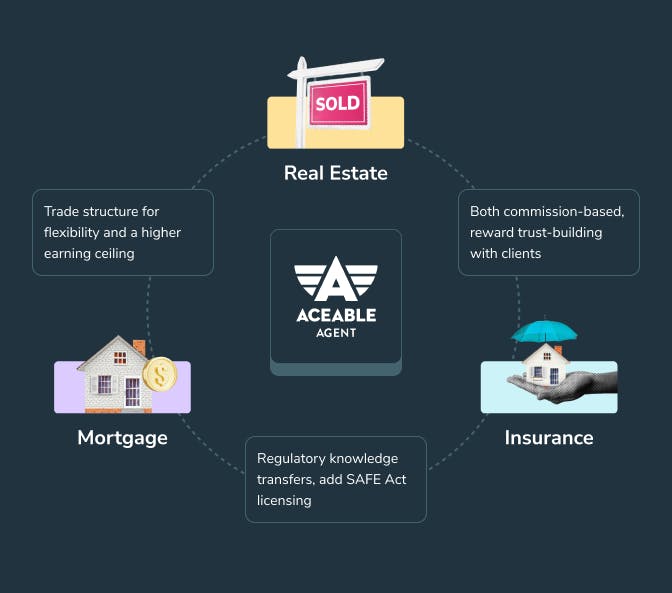
The homeownership industry runs on three careers, and women are already the driving force behind all of them. Two-thirds of real estate agents are women. Nearly 60% of the insurance workforce is women. And in mortgage, women just crossed the majority line and are still gaining ground. These aren't small footholds. Women are the ones finding the homes, protecting the investments, and financing the purchases that make homeownership possible for millions of Americans every year.
What makes this moment different is that the doors between these careers are wide open. The communication skills, client trust, and financial literacy you build in one field travel with you into the others. A real estate agent who adds an insurance license can protect the home she just helped a client buy. An insurance agent who picks up a mortgage credential can guide that same client through refinancing five years later. The client relationships don't end at the closing table. They grow. Some of the most successful professionals in this space hold licenses across two or even all three, building income streams that reinforce each other and creating the kind of career flexibility that a single license can't match.
If you're ready to explore where you fit, start here:
Real EstateUnlock Potential Real Estate Career · InsuranceYour Future In Insurance Starts Here Insurance.aceable.com · MortgageYour Future In Mortgage Starts Here Mortgage.aceable.com